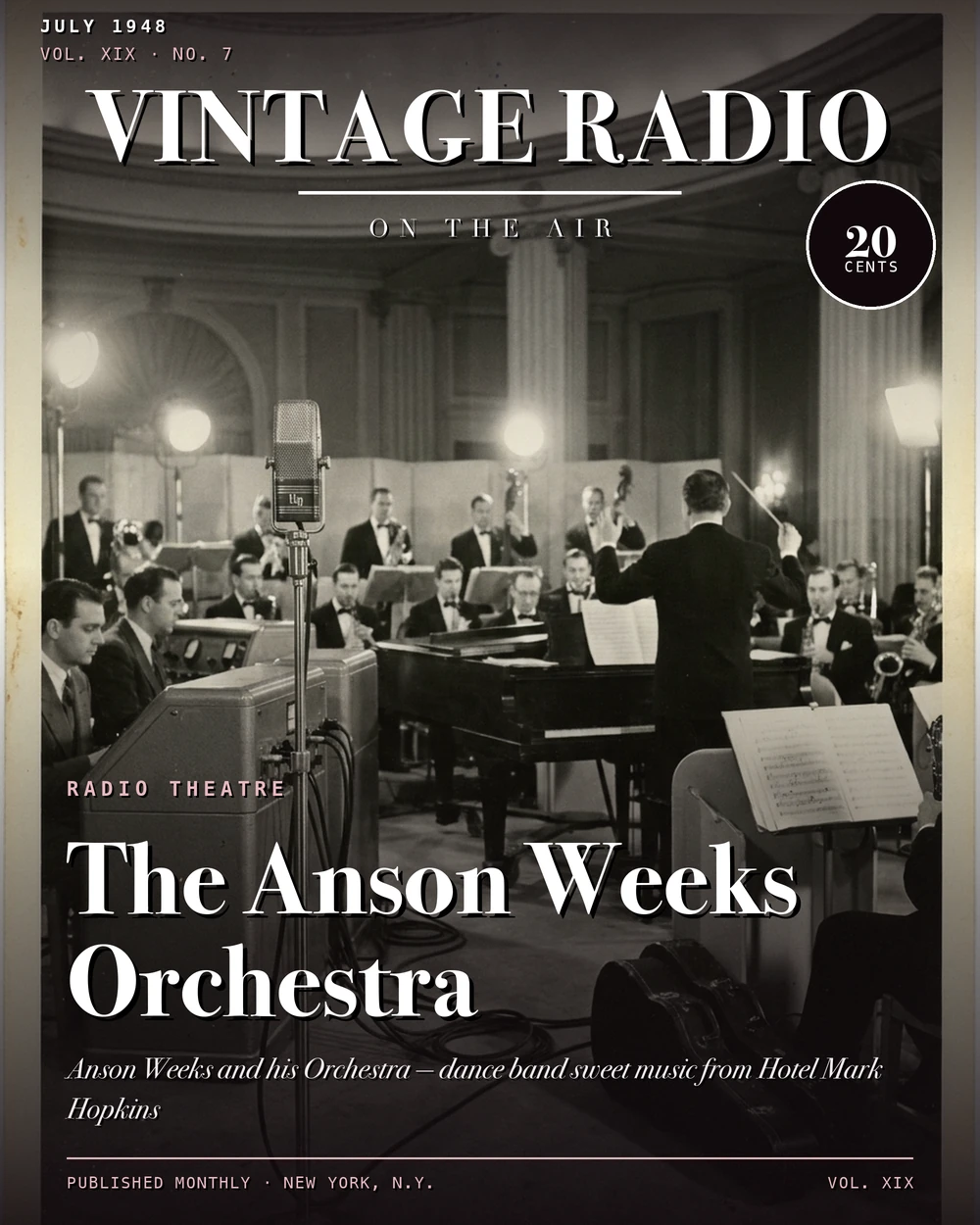
The Anson Weeks Orchestra
The Band Behind the Broadcasts
By the time the five episodes preserved in this catalog were recorded, circa 1931, Anson Weeks and his orchestra had already spent years building one of the West Coast's most recognizable sounds. Weeks was born in Oakland on February 14, 1896, and formed his first band in 1924. By 1927 he had landed what became a seven-year residency at the Hotel Mark Hopkins in San Francisco, performing in the hotel's Peacock Court ballroom — an elegant setting that shaped the orchestra's identity as much as anything else. The band began recording for Columbia in 1928, billed as "Anson Weeks & His Hotel Mark Hopkins Orchestra," and their promotional tagline, "Dancin' with Anson," stuck with them for decades.
Weeks played piano and led the band himself. The style he cultivated was what the era called "sweet" dance music — smooth, melodic arrangements built for romantic dancing, closer in spirit to Guy Lombardo than to the hot jazz and swing bands that would follow. The emphasis was on accessible tunes, tight ensemble playing, and a sound that worked on a ballroom floor just as well as it came through a radio speaker.
Nightly from the Peacock Court
Starting in 1930, the orchestra broadcast almost nightly from the Hotel Mark Hopkins over San Francisco station KFRC and NBC's West Coast network. Those nightly remote feeds became a fixture of West Coast radio, and they built the kind of audience familiarity that a weekly program couldn't quite replicate. The five episodes in this catalog were produced by the MacGregor & Sollie syndication service and presented as remote broadcasts from the Peacock Court, though research by early-radio historian Elizabeth McLeod indicates that Anson Weeks programs were also part of a Transcription Company of America series of simulated band remotes — recorded in the Transco studio but presented as live feeds from the hotel. Episode titles in the catalog — "I'll See You Again," "Dancing on the Ceiling," "You Try Somebody Else," "Lazy Day," "Good Night Little Girl, Good Night" — give a fair sense of the repertoire: popular songs, light and tuneful, suited to the dance-music format.
The band's national profile expanded considerably in late 1931 through "The Lucky Strike Magic Carpet Show," a coast-to-coast NBC program that originated from the Hotel Mark Hopkins and brought the orchestra to audiences far outside the West Coast. Additional sponsored programs followed, including "The Florsheim Shoe Hour" and "The Eddie Cantor Camel Show."
A Remarkable Roster
What makes the Weeks orchestra particularly interesting in retrospect is how many future names passed through it. Bob Crosby — Bing's younger brother — sang with the band from around 1931 to 1934, his first professional engagement. Tony Martin spent time as a vocalist, as did Dale Evans (well before her cowgirl years with Roy Rogers), Carl Ravazza, Donald Novis, and Harriet Lee. Griff Williams, who later led his own band, came up through the Weeks orchestra, and Xavier Cugat worked with the organization during the early 1930s as well. That's an unusually deep talent pool for a regional dance band, and it speaks to how seriously the Weeks operation was regarded at the time.
The orchestra's national standing in 1932 is illustrated by one particular session: the band accompanied Bing Crosby on his hit recording of "Please" that year — a track that reached a wide audience and placed Weeks squarely in the mainstream of American popular music. Weeks was also a composer; his original songs include his personal theme "I'm Writing You This Little Melody," along with "I'm Sorry Dear," "Señorita," and "We'll Get a Bang Out of Life."
After the Catalog Years
The catalog episodes capture the Weeks orchestra near its commercial peak. In 1932 the band signed with Brunswick and recorded prolifically through 1935, with a later session for Decca in 1937. By 1934 Weeks had expanded east, taking a residency at the St. Regis Hotel in New York and playing major ballrooms nationwide, including the Cocoanut Grove in Los Angeles and the Roosevelt in New Orleans. The seven-year Hotel Mark Hopkins run had launched a genuinely national career.
A serious bus accident in 1941 damaged Weeks's right arm and pulled him out of music for several years — he worked in car sales and real estate before returning to bandleading in the late 1940s. He signed with Fantasy Records in the early 1950s and recorded a series of dance albums under the old "Dancin' with Anson" title that stayed in the catalog through the 1970s. In 1956 he assembled a smaller seven-piece outfit for a long engagement at the Palace Hotel in San Francisco, closing a circle that had opened at the Mark Hopkins three decades earlier. Weeks died on February 7, 1969, a week shy of his seventy-third birthday.